[Español abajo]
October 27, 2025
Press Contacts:
Centro Comunitario de Trabajadores (for inquiries in Spanish):
Justice at Work:
Workers from Massachusetts and Rhode Island File Federal Lawsuit Against Major New England Seafood Company for Extortion and Wage Theft Practices
Plaintiffs sue Marder Trawling, Inc., Workforce Unlimited, Inc., for the illegal scheme of extortion and wage theft against workers at the Marder seafood plant in New Bedford, MA.
“We value our jobs and we want to work hard. But working under the extortion of our manager was depressing and infuriating. Each week, when we had to give our cash to the General Manager, it felt like an insult. He took our money every week, even though he understood exactly how hard we were struggling to make ends meet. He never even said thank you. Many of us fell behind on rent, bills, and taking care of our families, because we had no choice.”
– Joint Statement of the Named Plaintiffs
Boston, MA – Five individuals filed a federal lawsuit today on behalf of a class of workers against Marder Trawling, Inc., (Marder), and Workforce Unlimited, Inc., (Workforce) for allowing an illegal scheme where Plaintiffs were forced to pay extorted cash payments of approximately $100 per week to the Plant Manager at Marder as a condition of employment in violation of federal and Massachusetts law. In addition, Rhode Island residents contracted to work through Workforce were required to take specific transportation and pay approximately $60 per week as a condition of employment at the Marder seafood processing plant, in violation of state law. Marder is a leading wholesale seafood supplier in New Bedford, MA, and promotes sustainable seafood practices and a tradition of quality and integrity, which “values hard work, innovation, and dedication” within its workforce. But in fact, Marder and its agents profited from exploiting its workers through illegal extortion and wage theft. Plaintiffs bring this lawsuit to seek justice for all workers who experienced the same unjust and illegal mistreatment, and to prevent the defendants and other companies from profiting by illegally exploiting workers.
The lawsuit, filed in the U.S. District Court in Massachusetts, alleges that Marder, Workforce, and its owners and management violated state and federal labor laws. Despite the company’s avowed commitments to sustainability and integrity, Marder and other Defendants extorted and stole wages from Plaintiffs and subjected them to coercion, psychological abuse, hostile workplace conditions, and a discriminatory work environment. Defendants required Plaintiffs and other similarly situated individuals to pay weekly kickbacks averaging $100 per worker. Individuals employed through Workforce who required transportation from Rhode Island were also required to pay mandatory transportation fees of approximately $60 per week, in violation of the Massachusetts Temporary Workers Right to Know law.
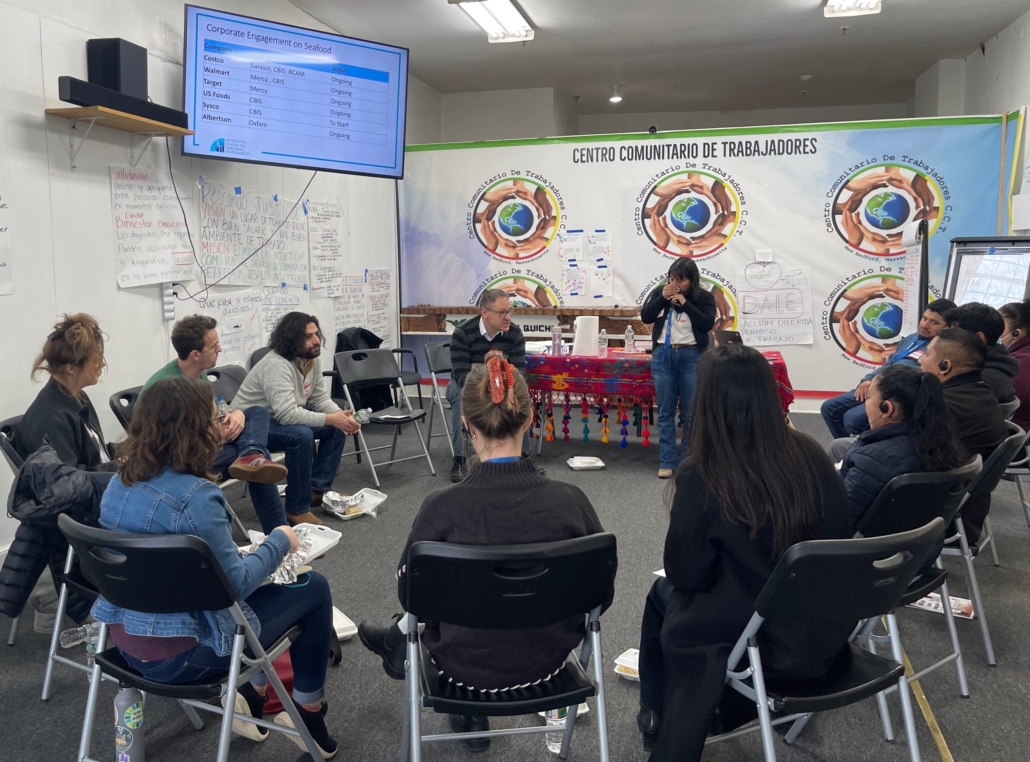
“I hope others in similar situations see this and know not to be afraid, to speak with whoever you need to talk to, and not continue suffering because of the injustices that affect you,” said Sergio Mejia, Centro Comunitario de Trabajadores (CCT) organizer and former seafood worker. The Plaintiffs first raised their voices against the abuse they suffered at Marder thanks to the help of New Bedford-based workers’ rights center CCT , which has supported other seafood processing workers in demanding dignity both at Marder and across the industry. “Marder and Workforce have contributed to a system of exploitation against workers in our community. It’s time for these companies to be made responsible for what happens under their watch. The law is harsh against workers–we are treated with suspicion and criminalized day to day–both at work and on the street. The owners, on the other hand, get away with allowing abuse and harassment and breaking the law,” states Adrian Ventura, Executive Director, CCT.
“State and federal laws protecting workers against wage theft have been on the books for decades. Despite these laws, seafood processors rely on the exploitation of underpaid labor. Pescando Justicia, a committee of seafood processing plant workers supported by CCT and Justice at Work, remains steadfast in their efforts to fight wage theft and exploitation in seafood processing. In 2020, Pescando Justicia invited seafood processors to follow the Code of Conduct, developed by CCT’s members, which establishes baseline standards for seafood processors to abide by and includes fair wages and better working conditions in seafood processing. Retailers who buy seafood, including large national grocery chains, can be assured that if their seafood supplier has adopted the Code of Conduct, their supply chains are fully compliant,” remarks Keally Cieslik, Senior Attorney, Justice at Work.
“Marder is among countless other companies that exploit the vulnerable community of immigrant workers with impunity. This country cannot allow powerful companies to use and abuse workers as a business model. We encourage the federal and state governments to act to protect all members of our communities,” states Keren Salim, Staff Attorney, Grassroots Law & Organizing for Workers.
Plaintiffs are represented by Justice at Work, a Massachusetts-based workers’ rights legal nonprofit, Grassroots Law & Organizing for Workers, a national workers’ rights nonprofit headquartered in Chicago, and Workers’ Law Office, based in Chicago.
About Centro Comunitario de Trabajadores (CCT): Founded in 2006, Centro Comunitario de Trabajadores (CCT) is dedicated to empowering immigrant workers in New Bedford, MA, by advocating for their rights, providing educational resources, and building a supportive community. Its goal is to ensure that every worker enjoys the dignity, safety, and opportunities they deserve.
About Justice at Work (JAW): Justice at Work is a multi-language legal services nonprofit based in Boston that, since 2011, has provided direct legal services, worker rights training, and strategic counsel to organizations of workers in low-paying jobs.
About Grassroots Law & Organizing for Workers (GLOW): GLOW uses a combination of law and organizing strategies to build transformative worker power and fuel the low-wage worker movement. Rooted in an unshakable belief in people power, we partner with worker organizations to challenge exploitative employment practices, empower workers, and fight for a world where our people and planet can thrive.
###
PARA PUBLICACIÓN INMEDIATA
27 de octubre de 2025
Contactos de prensa:
Centro Comunitario de Trabajadores: Adrián Ventura (aventura@cct-newbedford.org,774-961-8283)
Justice at Work: Connie Rab (crab@jatwork.org, 617-371-8952)
Trabajadores de Massachusetts y Rhode Island presentan demanda federal contra importante empresa de mariscos de Nueva Inglaterra por prácticas de extorsión y robo de salarios
Los demandantes demandan a Marder Trawling, Inc., Workforce Unlimited, Inc., por el plan ilegal de extorsión y robo de salarios contra los trabajadores de la planta de mariscos Marder en New Bedford.
“Valoramos nuestro trabajo y queremos trabajar duro. Pero trabajar bajo la extorsión de nuestro gerente era deprimente e indignante. Cada semana, cuando teníamos que entregarle nuestro dinero al gerente, lo sentíamos como un insulto. Nos quitaba el dinero todas las semanas, aunque entendía perfectamente lo mucho que nos costaba llegar a fin de mes. Ni siquiera nos daba las gracias. Muchos nos atrasamos con la renta, las facturas y el cuidado de nuestras familias: porque no teníamos otra opción.”
– Declaración conjunta de los demandantes nombrados
Boston, Massachusetts– Cinco personas presentaron una demanda federal en nombre de una clase de trabajadores contra Marder Trawling, Inc. (Marder) y Workforce Unlimited, Inc. (Workforce) por permitir un esquema ilegal donde los demandantes fueron obligados a pagar pagos en efectivo extorsionados de aproximadamente $100 por semana al gerente de planta en Marder como condición de empleo, en violación de leyes federal y de Massachusetts. En el caso de aquellos contratados para trabajar a través de Workforce que vivían en Rhode Island, se les exigió que tomaran transporte y pagaran aproximadamente $60 por semana a Marder y Workforce, y a sus respectivos agentes y empleados, como condición de empleo en la planta procesadora de mariscos de Marder. Marder es un proveedor mayorista de mariscos en New Bedford, MA, y promueve prácticas sostenibles y una tradición de calidad e integridad, que “valora el trabajo duro, la innovación y la dedicación” dentro de su fuerza laboral. Pero, de hecho, Marder y sus agentes se beneficiaron de la explotación de sus trabajadores mediante la extorsión ilegal y el robo de salarios. Presentamos esta demanda para buscar justicia para todos los trabajadores que experimentaron el mismo maltrato injusto e ilegal, y para evitar que los acusados y otras empresas se beneficien explotando ilegalmente a los trabajadores.
La demanda, presentada ante el Tribunal Federal de Distrito de Massachusetts, alega que Marder, Workforce y sus propietarios y directivos violaron las leyes laborales estatales y federales. A pesar de los compromisos declarados de la empresa con la sostenibilidad y la integridad, Marder y otros demandados extorsionaron y robaron salarios a los demandantes y los sometieron a coerción, abuso psicológico, condiciones laborales hostiles y un entorno laboral discriminatorio. Los demandados exigieron a los demandantes y a otras personas en situaciones similares que pagaran una compensación semanal promediando $100 por trabajador. Las personas empleadas a través de Workforce que necesitaban transporte desde Rhode Island también debían pagar tarifas de transporte obligatorias de aproximadamente $60 por semana, en violación de la ley estatal: Massachusetts Temporary Workers Right to Know.
“Espero que otras personas en situaciones similares vean esto y sepan que no deben tener miedo, que deben hablar con quien necesiten hablar y que no deben seguir sufriendo por las injusticias que les afectan”, dijo Sergio Mejía, organizador del CCT y ex trabajador de mariscos. Los demandantes alzaron la voz por primera vez contra el abuso que sufrieron en Marder gracias a la ayuda del Centro Comunitario de Trabajadores (CCT), con sede en New Bedford, que ha apoyado a otros trabajadores de procesamiento de mariscos en sus demandas de dignidad tanto en Marder como en toda la industria. El Departamento de Trabajo de EE. UU. ha investigado previamente a Workforce Unlimited por robo de salarios y otras violaciones laborales contra sus trabajadores.
“Marder y Workforce han contribuido a un sistema de explotación contra los trabajadores de nuestra comunidad. Es hora de que estas empresas rindan cuentas por lo que sucede bajo su supervisión. La ley es severa con los trabajadores: nos tratan con sospecha y nos criminalizan a diario, tanto en el trabajo como en la calle. Los dueños, por otro lado, se salen con la suya permitiendo el abuso y el acoso, e infringiendo la ley”, afirma Adrián Ventura, Director Ejecutivo del CCT.
“Las leyes estatales y federales que protegen a los trabajadores contra el robo de salarios han estado vigentes durante décadas. A pesar de estas leyes, los procesadores de mariscos dependen de la explotación de mano de obra barata y vulnerable. Pescando Justicia, un comité de trabajadores de plantas procesadoras de mariscos apoyado por CCT y Justice at Work, se mantiene firme en sus esfuerzos para combatir el robo de salarios y la explotación en el procesamiento de mariscos. En 2020, Pescando Justicia invitó a los procesadores de mariscos a seguir el Código de conducta, desarrollado por los miembros del CCT, que establece estándares básicos que deben cumplir los procesadores de mariscos e incluye salarios justos y mejores condiciones laborales en el procesamiento de mariscos. Los minoristas que compran mariscos, incluidas las grandes cadenas nacionales de supermercados, pueden tener la seguridad de que, si su proveedor de mariscos ha adoptado el Código de Conducta, sus cadenas de suministro cumplen plenamente con él”, comenta Keally Cieslik, abogada sénior de Justice at Work.
“Marder se encuentra entre innumerables empresas que explotan con impunidad a la vulnerable comunidad de trabajadores inmigrantes. Este país no puede permitir que empresas poderosas utilicen y abusen de los trabajadores como modelo de negocio. Instamos a los gobiernos federal y estatal a actuar para proteger a todos los miembros de nuestras comunidades”, afirma Keren Salim, abogada de Grassroots Law & Organizing for Workers.
Los demandantes están representados por Justice at Work, una organización legal sin fines de lucro que defiende los derechos de los trabajadores con sede en Massachusetts, Grassroots Law & Organizing for Workers, una organización nacional sin fines de lucro que defiende los derechos de los trabajadores con sede en Chicago, y Workers’ Law Office, con sede en Chicago.
Acerca Centro Comunitario de Trabajadores (CCT): Fundado en 2006, el Centro Comunitario de Trabajadores (CCT) se dedica a empoderar a los trabajadores inmigrantes en New Bedford, Massachusetts, defendiendo sus derechos, proporcionando recursos educativos y construyendo una comunidad solidaria. Su objetivo es garantizar que cada trabajador disfrute de la dignidad, la seguridad y las oportunidades que merece.
Acerca de Justice at Work (JAW): Justice at Work es una organización sin fines de lucro que ofrece servicios legales en varios idiomas y tiene su sede en Boston que, desde 2011, ha brindado servicios legales directos, capacitación sobre derechos de los trabajadores y asesoramiento estratégico a organizaciones de trabajadores en empleos mal remunerados.
Acerca Grassroots Law & Organizing for Workers (GLOW): GLOW utiliza una combinación de leyes y estrategias organizativas para construir un poder transformador para los trabajadores e impulsar el movimiento de trabajadores con bajos salarios. Con una firme convicción en el poder popular, colaboramos con organizaciones de trabajadores para combatir las prácticas laborales explotadoras, empoderar a los trabajadores y luchar por un mundo donde nuestra gente y nuestro planeta puedan prosperar.
###